Not My Fault: How the Blame Game Shapes Public Institutions
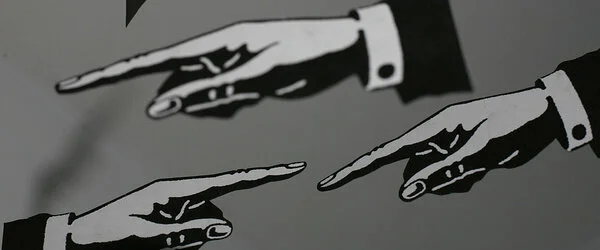
A common gripe against public international institutions is that they are unable to provide sound quality of service. Christopher Hood’s latest book on the subject, The Blame Game: Spin, Bureaucracy, and Self-Preservation in Government, offers a simple explanation and theory as to the reason institutions are unable to fulfill customer expectations. The simple answer is that individuals working for institutions spend all their time blaming others rather than working to solve issues that arise. The reason for this type of behavior is that individuals working within institutions are consumed with fear of reprimand. Furthermore, progress is only modestly noted while reprimand is viewed as a lifelong blemish. Thus whenever an individual feels they may potentially be considered at fault their only refuge is to point the finger at someone else. Obviously this prohibits the institution from improving and does nothing to address quality of service. The customer is lost in this blame game.Hood develops a sophisticated theory around this simple explanation. The theory includes three common strategies to cast blame when desired: Presentation, Agency, and Policy. The presentation strategy involves controlling information or asserting that an outsider is the problem. Agency strategy is blame leveled at the agency’s organization. Policy strategy is blame that is based on rules that are made by the institution. These three strategies are further explored as they are applied by an institution’s decision makers, from senior-level managers to individuals that execute tasks on a day-to-day basis.Hood elaborates on his theory throughout the book, providing a map of the form blame can take within an institution. (Ironically, an unintended effect is that the book can also serve as a guide for anyone who wants to employ blame tactics to their advantage.)The Blame Game is filled with numerous illustrations of how public servants divert, deny, and contain blame, and some of the most interesting cases show how prime ministers use their staff to ward off attacks on the government or to shift blame to another entity altogether. One memorable example involves the former prime minister of Italy, Romano Prodi, deflecting criticism for not resolving a problem of trash going uncollected on the street corners of Naples. Prodi employed a brilliant use of presentation strategy to avoid reprimand: He overcame blame by creating a new “trash czar” to determine why trash was not picked up, and then fix the problem once and for all. In deploying his czar, the PM effectively pinned blame for the trash problem on some force outside of his direct control. Through examples like this and others, Hood makes clear the role that blame plays in the affairs of institutional life.The effects of blame are not limited to individuals, however, and Hood goes on to explore the way blame can change the entire functional scope of an institution. A case-in-point is the growing prevalence of “defensive medicine”. In defensive medicine, doctors seek to avoid blame by conducting additional testing for every conceivable patient malady. The medical field is evolving this way in response to the increased risk of malpractice lawsuits. The rise in defensive medicine has caused some doctors to move their practices to rural jurisdictions where cautionary tests are less required. Patients are thus forced to travel greater distances to meet with qualified doctors. The blame game, Hood argues, is responsible for changing the entire location and manner of providing a service.Unfortunately, the game may be worsening. Why? Hood points to increased media scrutiny. As the world finds itself confronted with an increased news presence, a greater amount of attention is focused on the ineffectiveness of institutions, which, in turn, are now struggling to respond to the onslaught of blame leveled at them. This trend has had an impact at the highest levels of government. The role and importance of the White House Press Secretary, for instance, has risen drastically over the past decades to deal with blame. During the Eisenhower administration there were only three staff members that worked in press affairs. Today there are around fifty.Unfortunately we are never given solutions as to how to get out of the blame game, and by the end of the book the reader is left with the impression that institutions will suffer from blame strategies indefinitely. This is a gross overgeneralization—institutions are indeed able to make improvements in accountability. For example, we can consider the case of assistance to Haiti after its devastating earthquake in 2010. Though far from perfect, the assistance did overcome a number of institutional cooperation deficiencies. Rather than dwell on inter-organizational errors, aid was provided and help was offered. Some possible explanations might be the short timetable organizations were forced to work with immediately after the quake and the life-or-death nature of the problem. In these cases blame is looked at unsatisfactorily, and solutions are looked on favorably.Though The Blame Game offers no solutions, Hood’s theory of blame and analysis of organizational behavior is certainly thought-provoking for those interested in better understanding the challenges facing institutions internally. It also provides helpful insight for those who work or deal with such organizations on a frequent basis.
About the Book: Hood, Christopher, The Blame Game: Spin, Bureaucracy, and Self-Preservation in Government, Princeton University Press, 2011. 226 pages. US $39.95
Image courtesy of jetheriot via Flickr